ODARA (Ontario Domestic Assault Risk Assessment)
Overview
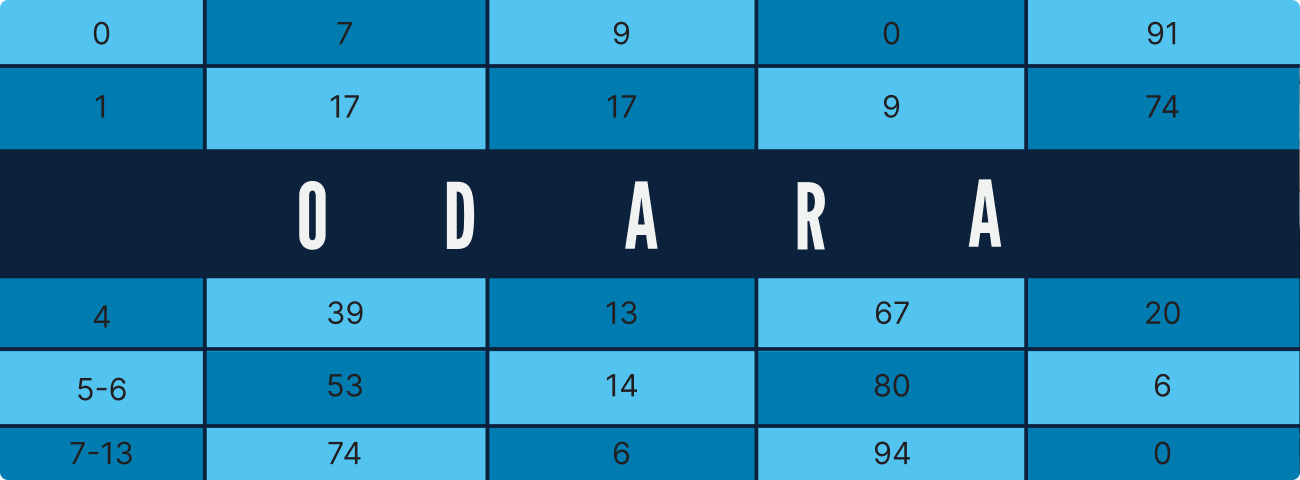
The ODARA is a 13 item actuarial instrument created by N. Zoe Hilton, Ph.D., and colleagues at the Mental Health Centre Penetanguishene, in collaboration with the Ontario Provincial Police, and first published in 2004 by N. Zoe Hilton, Grant T. Harris, Marnie E. Rice, Carol Lang, Catherine A. Cormier, and Kathryn J. Lines. The ODARA is primarily for use with adult men with a history of physical violence against an intimate partner and can also be used with adult women. The ODARA is one of the most widely used intimate partner violence risk assessment instruments in Canada and is extensively used in the United States and some European nations.
For coding questions on the ODARA, users should first consult the full scoring manual, available here:
- Domestic Violence Risk Assessment, 2nd edition
- Chapter 6, Scoring manual for the Ontario Domestic Assault Risk Assessment, can also be purchased separately for under $20 USD at APA PsycNet
Users may also direct coding questions to an ODARA Independent Trainer found on this page [beginning Fall, 2025].
- All questions for ODARA may be submitted to: [email protected]
Policy and Practice
The full scoring manual should always be used when scoring the ODARA; the ODARA scoring sheet alone should not be relied upon.
The American Psychological Association (APA) holds the copyright to the ODARA scoring manual. Permission to reproduce these documents, in whole or in part—including for use in an offender records management system—must be obtained from the APA.
Details about permissions policies, application forms, and procedures are available through the APA’s Seek Permission page. Additional copyright and permissions information is available on the APA’s Copyright and Permissions Information page.
Official translations of the ODARA are available in French through ODARA 101, hosted by Waypoint Centre for Mental Health Care at https://odara.waypointcentre.ca and in German at https://www.knfp.ch/en/risk-assessment-tools/odara. Official translations into other languages must be approved by a certified ODARA trainer fluent in the target language, including approval of the English back-translation by an ODARA Independent Trainer.
Categories
Scoring Manuals
Intimate Partner Violence: Treatment Needs and Evidence-Based Treatment Planning

Domestic Violence Risk Assessment: Stories and Algorithms
Brief Overview of the Ontario Domestic Assault Risk Assessment (ODARA)
Strategic Planning: Maine’s Roadmap to Implementing Risk Assessment
Trainings
Access specialized training to deepen your understanding of our assessment tools.
Build the knowledge and skills needed for accurate, evidence-based practice.

Formation au VRAG-R -Septembre 2026
Risk Matrix 2000 Training - October 2026
STABLE-2007 Training - September 2026
Static-2002R Training - November 2026